
< Home
Modular Synthesizer
This project began as my first foray into analog electronics at the end of high school, and I have been working on it ever since. Inspired by musicians like Klaus Schulze, Tangerine Dream, and Vangelis, I wanted to practice composing and performing music with the synthesizer. And seeing some impressive DIY projects online by Look Mum No Computer and others, I decided to go ahead and build my own analog system. DIY was also attractive to me because I had wanted to learn more about circuit design, and I thought I would get more out of a system I built up over time rather than paid lots of money for up front.
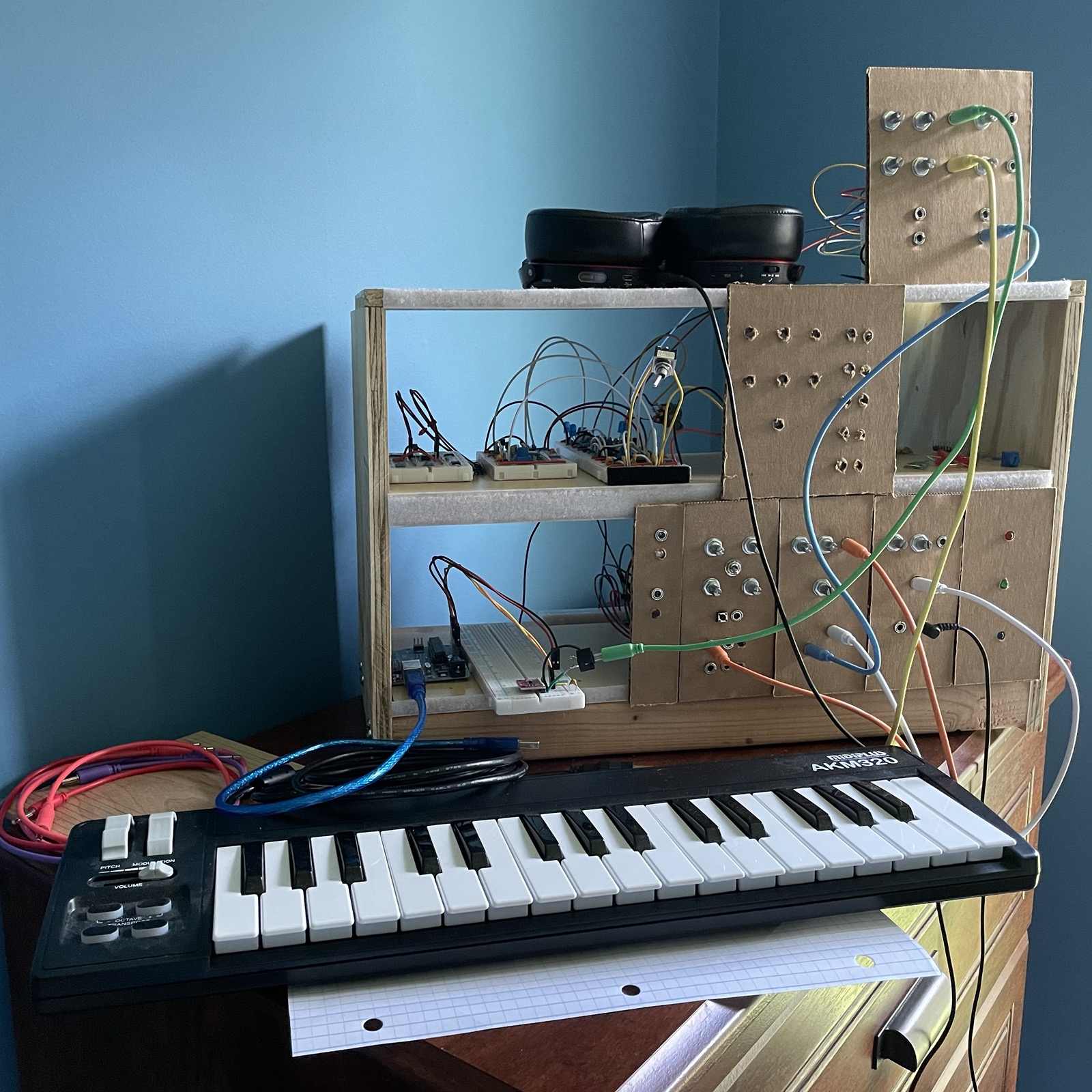
The system went through multiple iterations, the first of which being made of cardboard and breadboards:
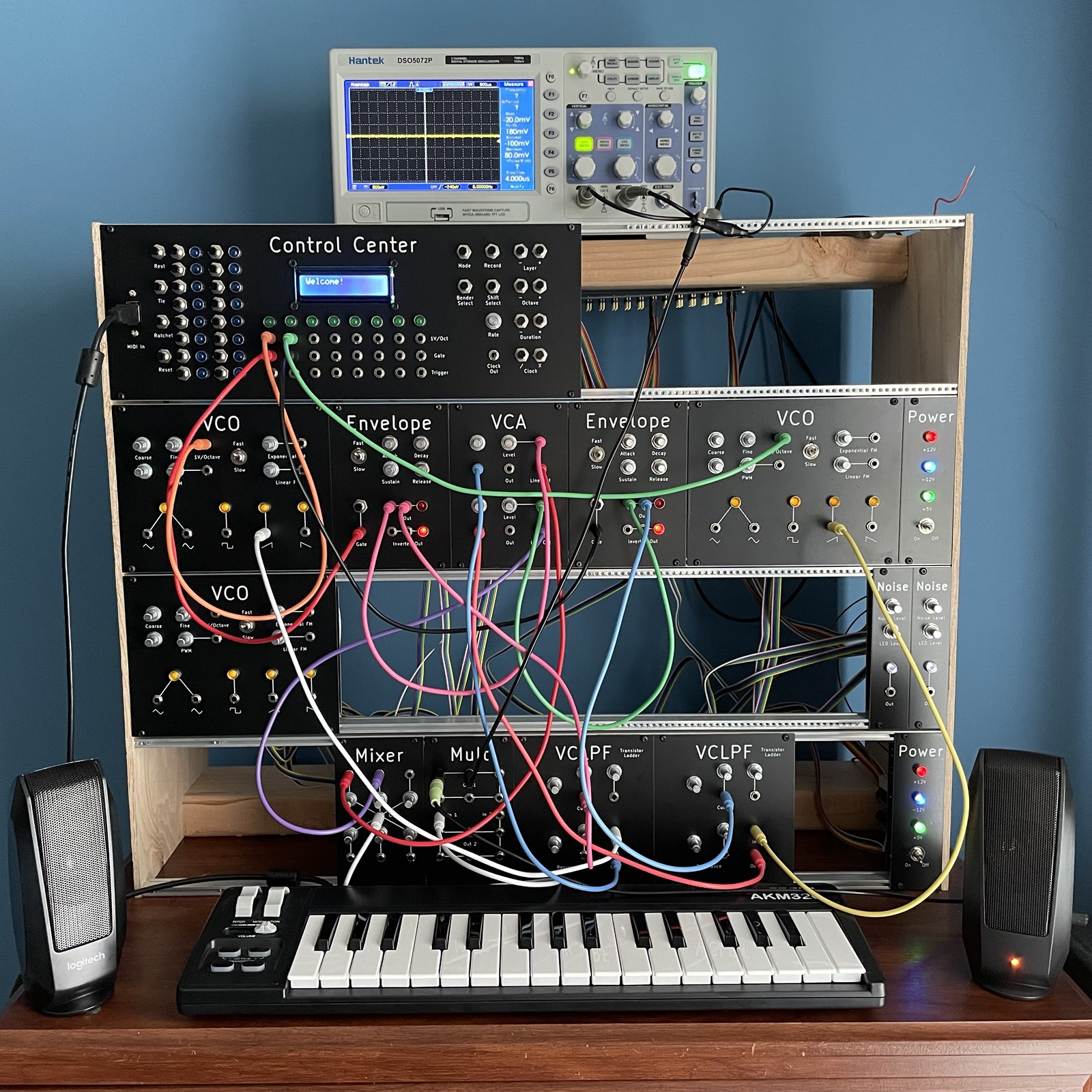
Eventually, I started making PCBs for the breadboarded circuits and built a larger case:
Here is what the system looked like after making some more modules and a separate drum machine unit:
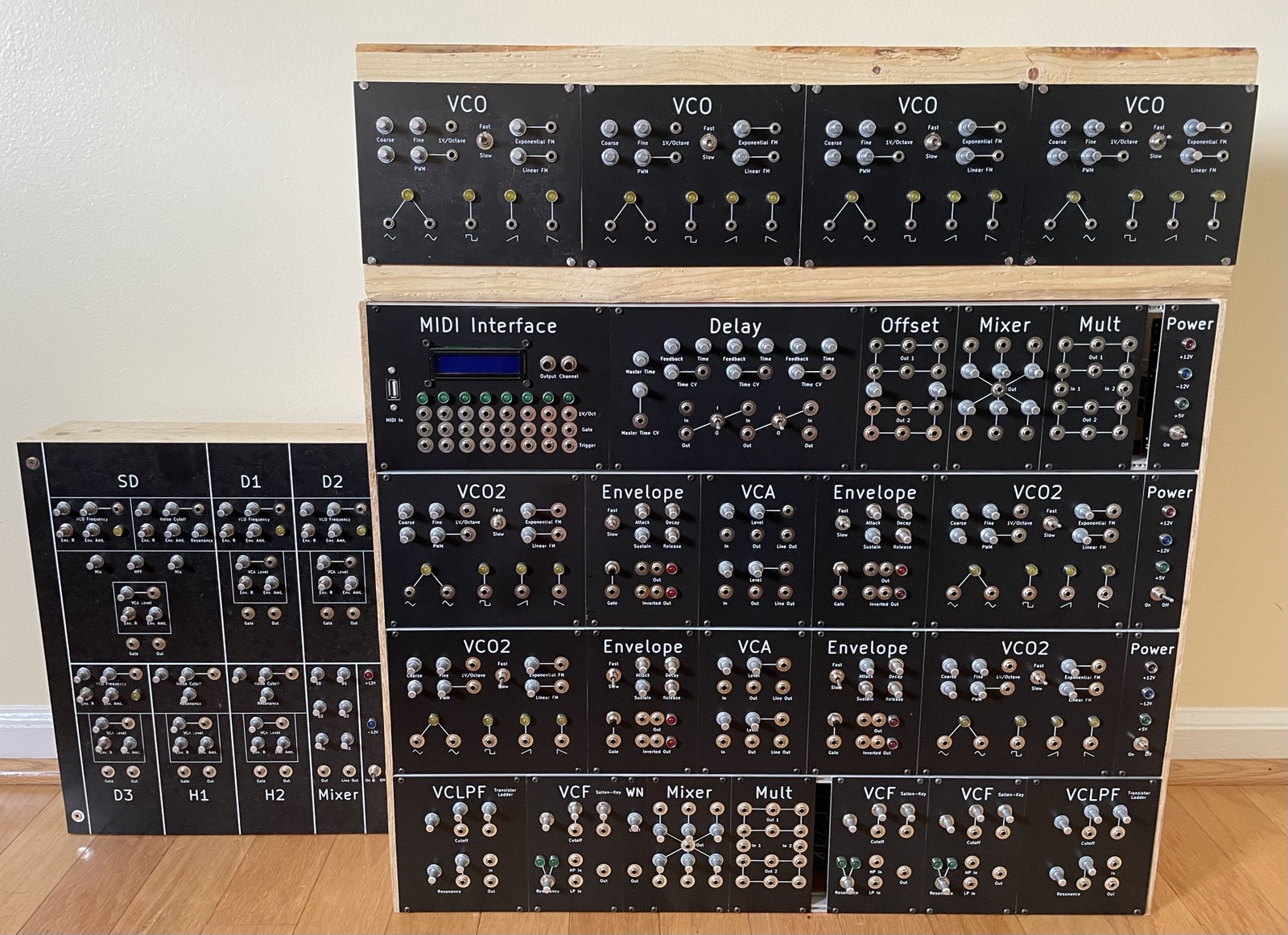
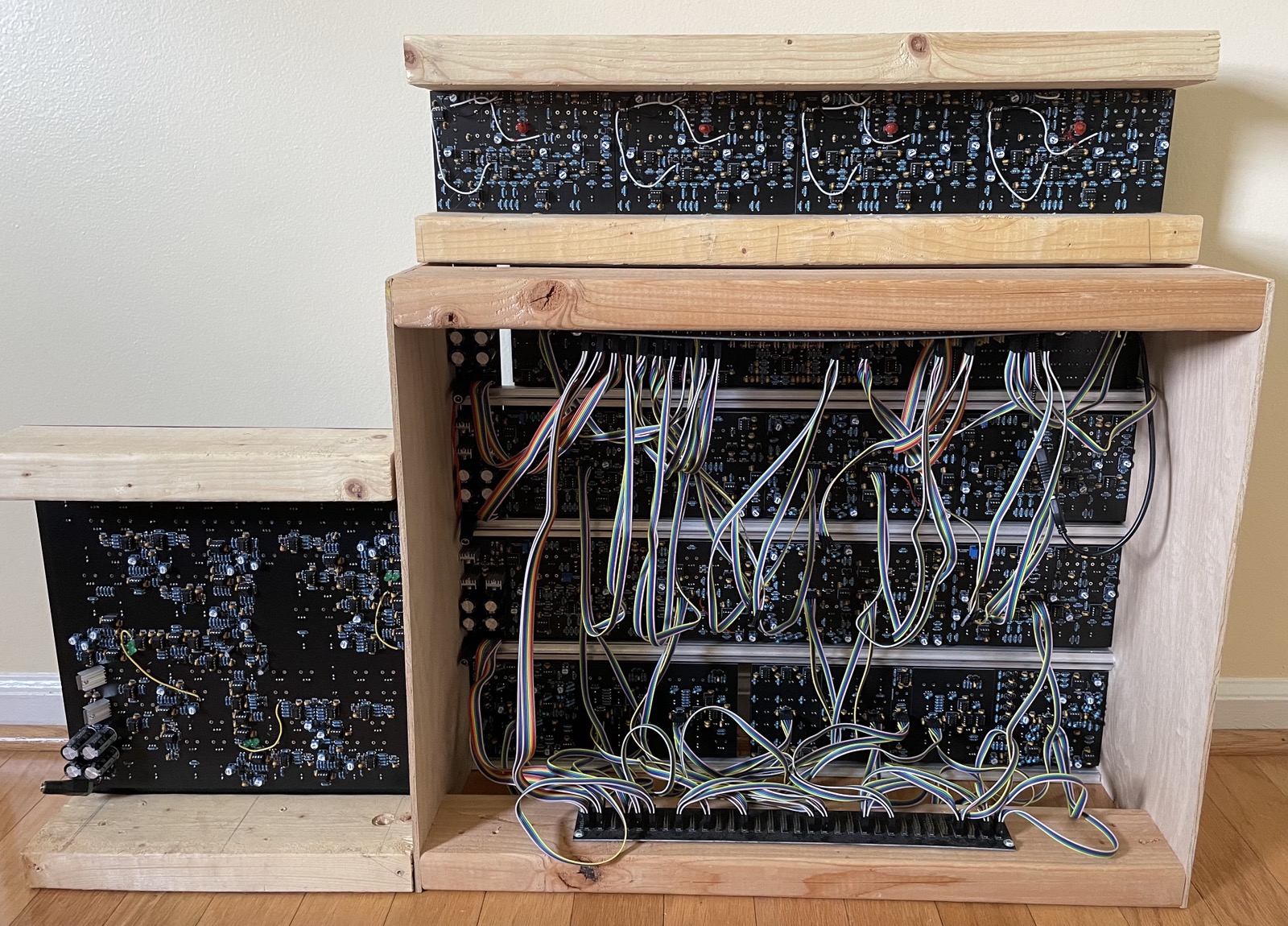
This iteration of the system was rather noisy due to poor PCB routing on some of the boards, poor power distribution (tiny power cables all connected thin PCB busbars), and a MIDI interface whose Rasperry Pi computer injected significant digital noise on the supply. The modules also took up a large amount of space in the case, so I couldn't expand the system without building another case. Over time, I redesigned all of the modules to be more compact and use separate signal and chassis grounds (avoiding ground loops in the current-carrying signal ground). I also built a new power supply and distribution system using 16 awg cables and thick aluminum busbars. This is the synthesizer in its current form:
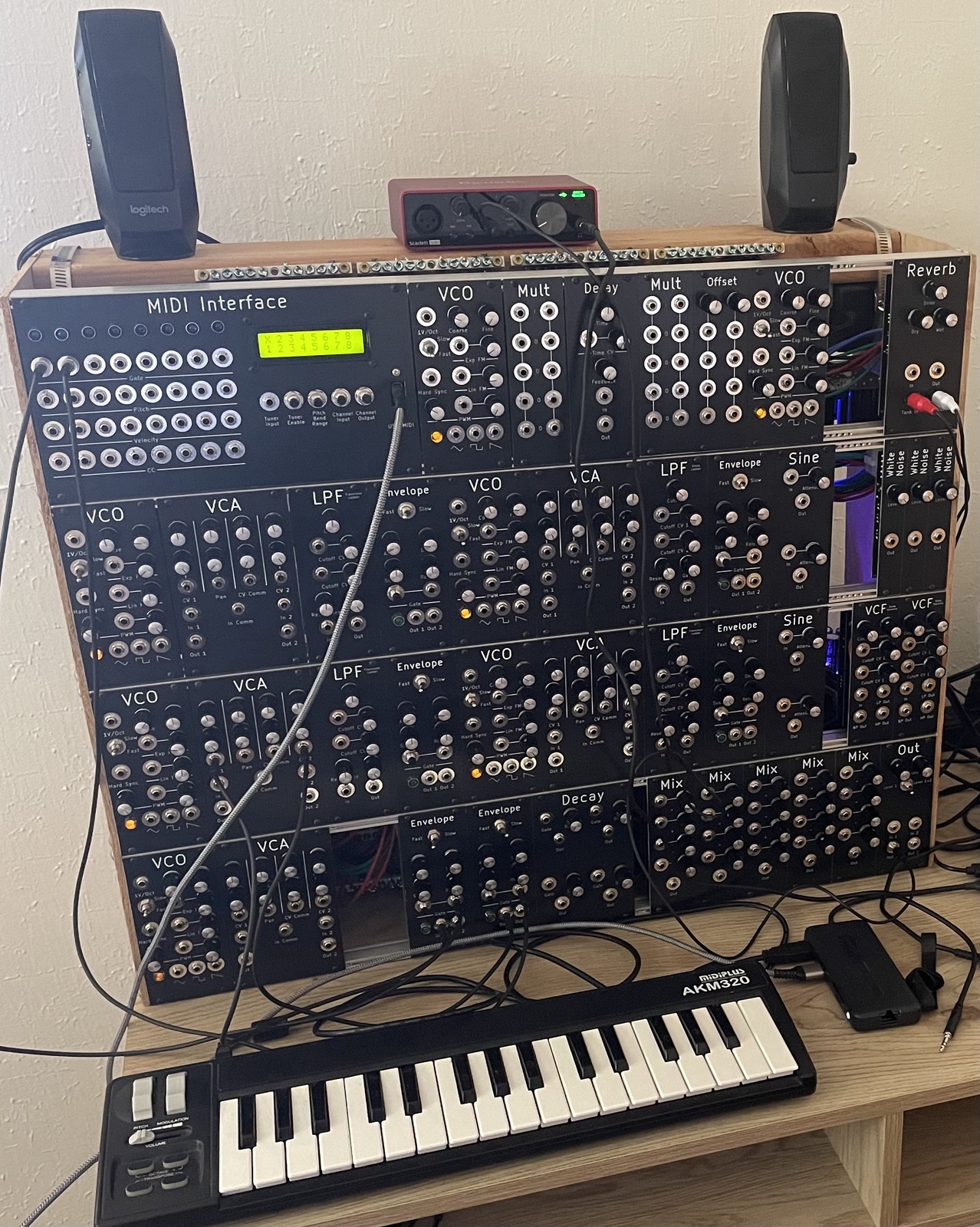
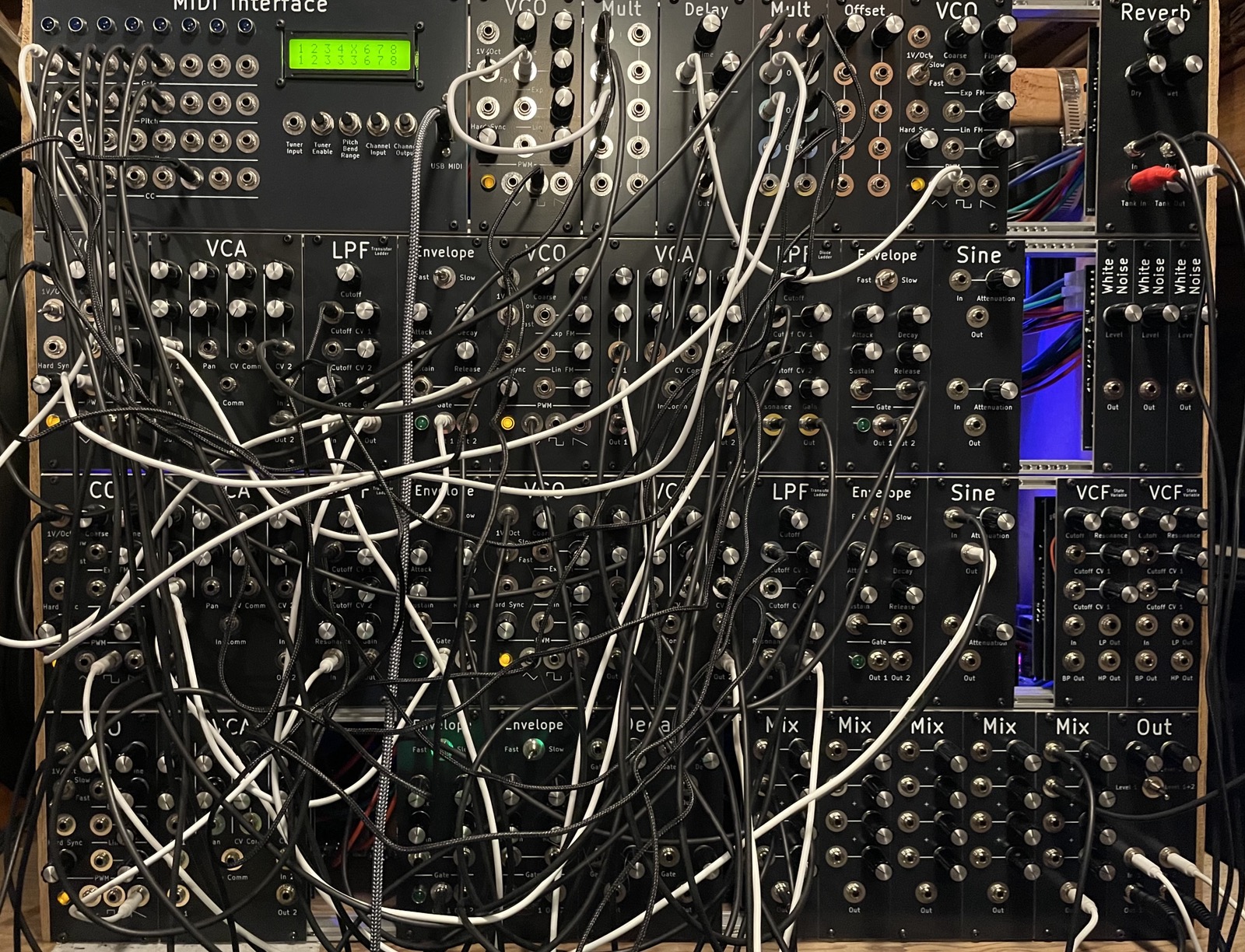
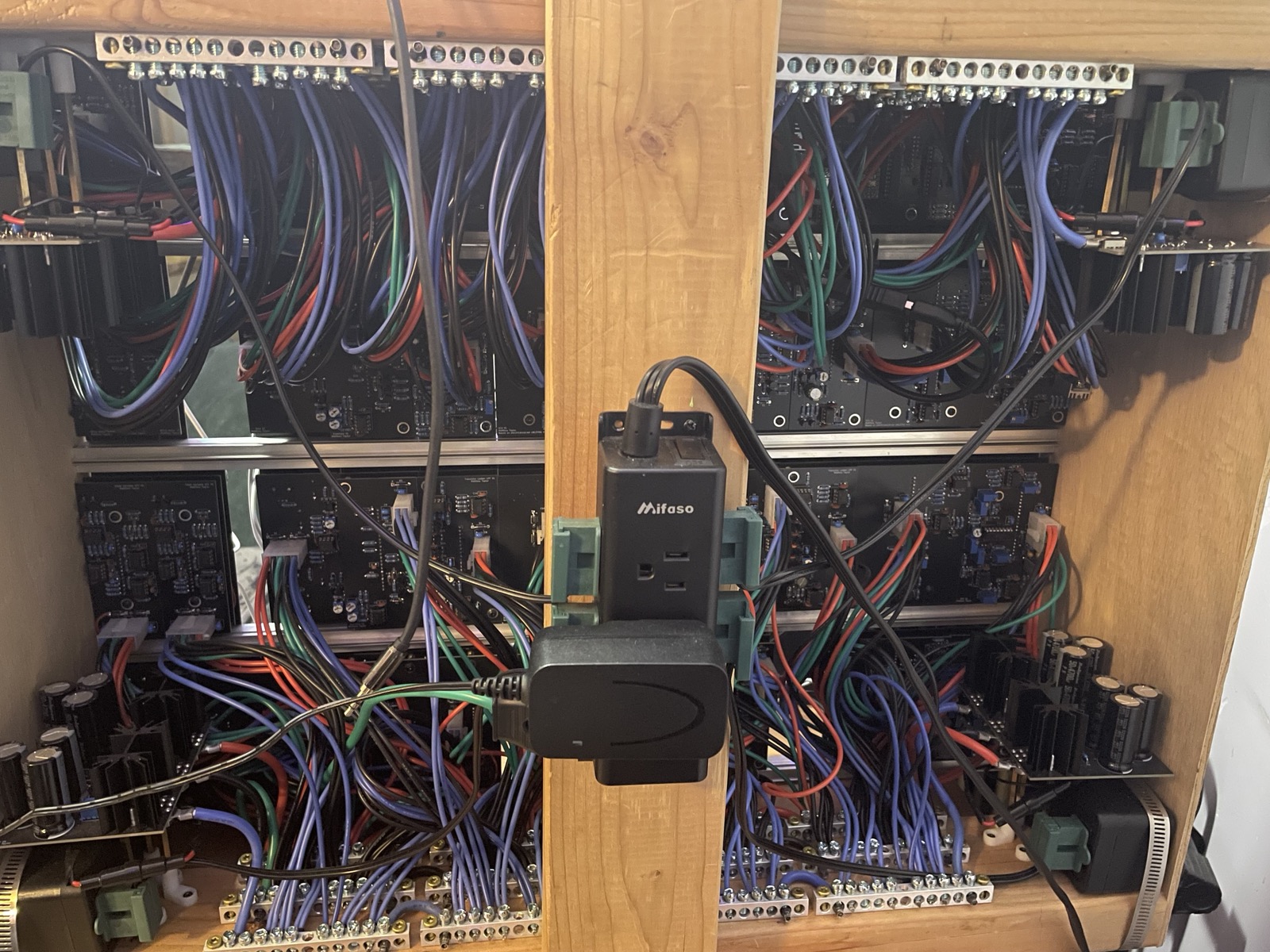
Below is a list of the modules currently used in the synth:
- Sources
- 7 voltage-controlled oscillators made using the AS3340 IC for stable tuning. May be used as either an audio-rate or low-frequency oscillator.
- 3 noise sources (BJT in avalanche mode).
- Voltage-Controlled Filters
- 3 transistor ladder low-pass filters based on the filters used in many Moog instruments.
- 1 diode ladder low-pass filter based on the filter used in the TB-303.
- 2 state variable filters (high-pass, low-pass, band-pass) based on the filter used in the Oberheim SEM.
- Voltage-Controlled Amplifiers
- 5 dual voltage-controlled amplifiers, each capable of voltage-controlled stereo panning.
- Envelope Generators
- 6 ADSR envelope generators made using the 555 timer.
- 4 decay-only envelope generators (short attack time).
- Audio Effects
- 4 soft-clipping distortion modules, which work by saturating the BJTs in a differential pair configuration. May be tuned to provide approximate triangle-to-sine waveshaping.
- PT2399 delay.
- Spring reverb.
- Utilities
- 5 4-to-1 mixers.
- 4 1-to-4 active mults.
- 2 balanced outputs.
- USB MIDI Interface
- Supports up to 8 channels of pitch/gate/velocity/CC outputs and has a built-in tuner.